Benazir Income Support Programme: A Complete Guide for Pakistani Families
Most people who need help from the Benazir Income Support Programme already know it exists. What they don’t know — and what quietly costs them real money — is how the system actually works, who truly qualifies, how payments reach them, and what to do when things go wrong. The Benazir Income Support Programme isn’t complicated once you understand its logic. Quikzap has put together this guide to walk Pakistani readers through every layer of the programme, from the poverty scoring method that decides eligibility to the sub-programmes that extend support beyond basic cash transfers. Whether you’re in a city flat in Karachi or a village outside Dera Ismail Khan, this covers what you need to know.
What Is the Benazir Income Support Programme?
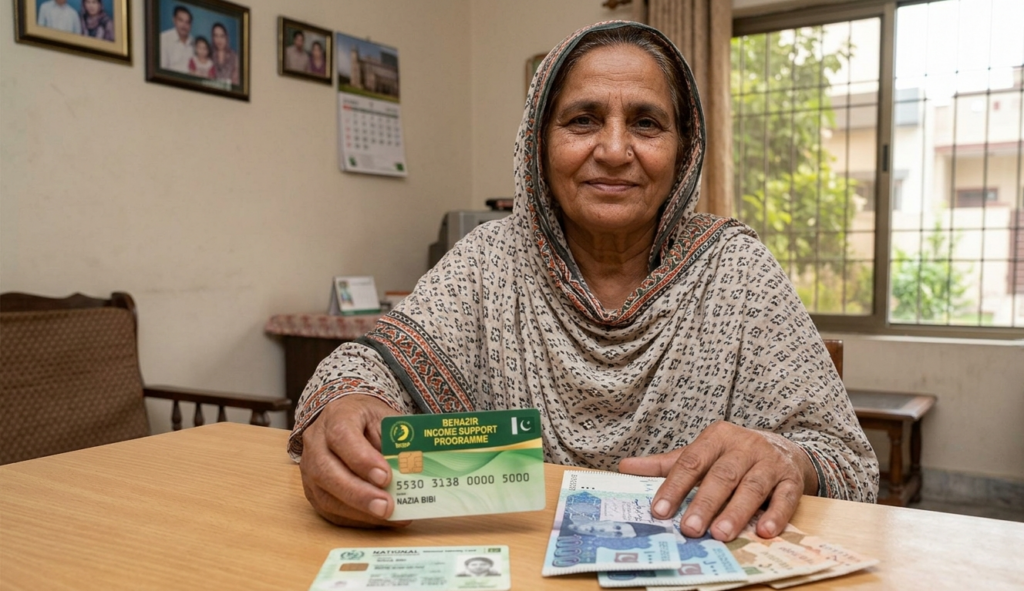
The Benazir Income Support Programme is Pakistan’s largest federal social protection programme — an unconditional cash transfer scheme that distributes direct payments to the country’s lowest-income households, with women as the designated primary recipients. Launched in July 2008 under the government of Yousaf Raza Gillani and named in honour of former Prime Minister Benazir Bhutto, it was born from a straightforward observation: inflation and the rising cost of food and fuel were cutting the purchasing power of poor families faster than any available safety net could compensate. Rather than routing money through intermediaries or tying payments to conditions like job training, the Kafalat cash transfer component simply deposits funds quarterly into the hands of women who need it most. That design choice — direct, female-targeted, no conditions — is what distinguishes the Benazir Income Support Programme from a general government subsidy, which typically reduces the price of a commodity for everyone regardless of income.
The scale of the Benazir Income Support Programme is staggering by any regional standard. Its annual budget allocation crossed Rs. 700 billion in the most recent federal budget cycle — making it the government’s third-largest spending line after debt servicing and defence. Think of it less like a welfare cheque and more like a pressure valve: millions of households are just barely on the right side of a collapse that rising inflation, low wages, and inadequate employment consistently push them toward. The programme holds that valve open. The Ehsaas programme framework, introduced later as an umbrella social protection brand, operates extensively through the Benazir Income Support Programme’s existing infrastructure — the same NADRA verification backbone, the same NSER database, the same 8171 portal — which means the two are more intertwined in practice than their separate branding suggests.
How the Programme Works
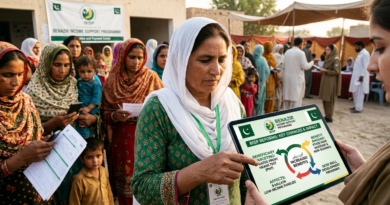
The operational engine behind the Benazir Income Support Programme is the National Socio-Economic Registry, or NSER — a national household database built from door-to-door surveys conducted by Benazir Income Support Programme field teams. Every household that participates in the NSER survey receives a poverty scorecard in the form of a PMT score (Proxy Means Test), a number between 0 and 100 calculated using more than 20 data points: housing type, utilities access, number of dependents, education levels, land ownership, assets like a motorcycle or air conditioner, and estimated household income. The lower the score, the more severe the poverty — and the stronger the claim to support. Households with a score below 32 are generally considered eligible for the core Kafaalat cash transfer, with some recent policy adjustments placing the active threshold closer to 34 for certain sub-programmes. Crucially, the registry is dynamic, not fixed — families can request a re-survey when their circumstances change, and scores are updated accordingly, roughly every two to three years or upon request.
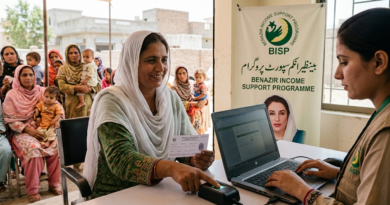
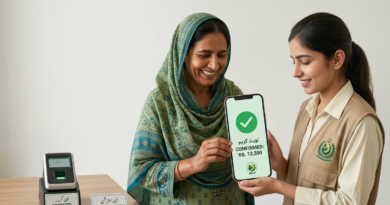
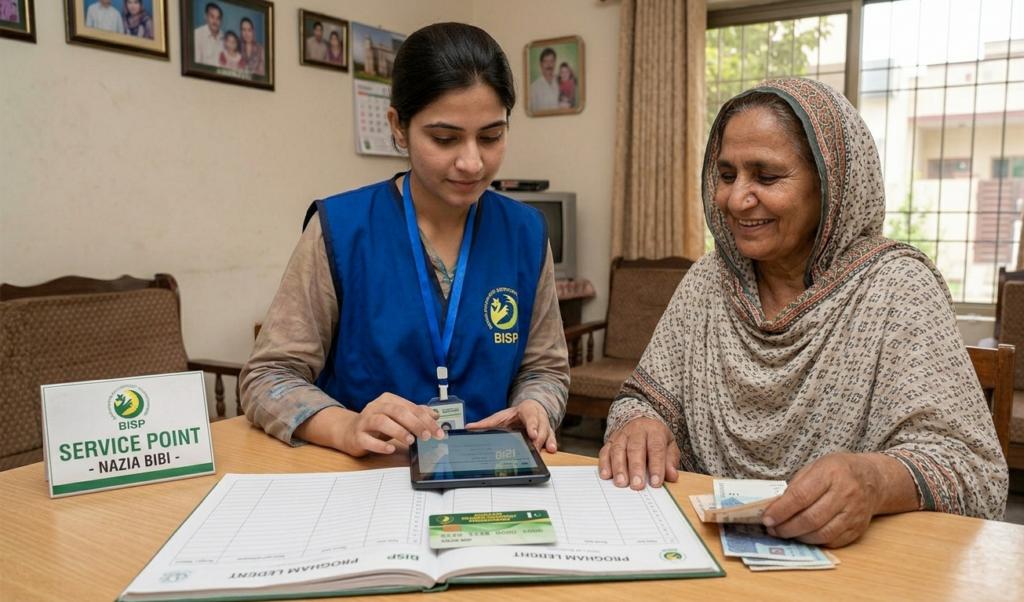
Before a single rupee moves, NADRA verification must clear. Every applicant’s CNIC is cross-checked against NADRA’s central database to confirm identity, marital status, family composition, and that no conflicting records exist. An expired CNIC, a name mismatch, or a SIM card registered under someone else’s identity can all block payment at this stage. Once cleared, payments are released quarterly through a network of disbursement channels. The most widely used is HBL — beneficiaries can withdraw funds at HBL ATMs and HBL Konnect outlets using biometric verification. Bank Alfalah branches cover certain regions, including parts of Azad Jammu and Kashmir. Mobile wallets — JazzCash and EasyPaisa — have been added as payment options, particularly for the growing segment of beneficiaries who now hold SIM cards registered on their own CNICs. Benazir Income Support Programme camp sites are set up periodically in areas where permanent banking infrastructure is sparse, bringing payment points into remote communities rather than asking those communities to travel.
| Programme Layer | Function | Responsible Body | Beneficiary Touchpoint |
|---|---|---|---|
| NSER Dynamic Survey | Collects household socioeconomic data; generates PMT poverty score | BISP field enumerators | Home visit or BISP office walk-in |
| NADRA Verification | Confirms identity, CNIC validity, family record accuracy | NADRA | Automatic cross-check; no separate application needed |
| Eligibility Determination | PMT score assessed against eligibility threshold | Benazir Income Support Programme central system | Result viewable via 8171 portal or SMS |
| Quarterly Payment Disbursement | Rs. 13,500–14,500 released per eligible beneficiary each quarter | HBL, Bank Alfalah, JazzCash, EasyPaisa, BISP camps | ATM withdrawal, mobile wallet, camp collection |
| Beneficiary Status Check | Real-time eligibility and payment tracking | Benazir Income Support Programme 8171 system | SMS to 8171, or visit 8171.bisp.gov.pk |
| Grievance Resolution | Complaints, re-surveys, payment disputes | Benazir Income Support Programme tehsil office / Benazir Income Support Programme helpline | In-person visit or helpline call |
Eligibility Criteria and Registration Process
Who Qualifies
The primary applicant must be a female — specifically, the female head of a qualifying household. This encompasses married women managing household finances, widows, divorced women, and those who are separated. The household must have completed the NSER dynamic survey, and the resulting PMT score must fall below the active eligibility threshold. Families whose monthly income is below Rs. 25,000 — and who hold no significant assets such as registered land, a private vehicle, a business, or a passport indicating foreign travel — are the profile the Benazir Income Support Programme is designed to serve. Government employees and pensioners are excluded. Receiving another formal state salary or pension typically pushes a household’s PMT score above the qualifying band.
Documents Required
- Valid, unexpired CNIC of the female applicant — this is the single most critical document; an expired card blocks the entire process
- B-Forms (Child Registration Certificates) for all children under 18 in the household, verified against NADRA’s database
- Proof of residence — a utility bill, union council letter, or tenancy document accepted at Benazir Income Support Programme survey centres
- Divorce certificate or death certificate where applicable — widows and divorced women are priority categories and this documentation strengthens their file
- Active mobile number registered on the applicant’s own CNIC — essential for receiving payment confirmation SMS and for mobile wallet disbursement
New Registration — How It Works
- Locate the nearest Benazir Income Support Programme tehsil office or NSER survey centre — the 8171 helpline can provide the address for your area
- Visit with all required documents and request the NSER registration form
- A BISP enumerator may be assigned for a home visit, or the form can be completed at the office, depending on survey cycle activity in your district
- Submit the form; you’ll receive an SMS on your registered mobile confirming the application reference
- Once data is processed, check your PMT score and eligibility status via the 8171 portal or by texting your 13-digit CNIC to 8171
What Disqualifies an Applicant
Owning a registered vehicle, holding a passport with foreign travel stamps, having a government job or pension, or possessing significant agricultural land will raise the PMT score above the eligibility threshold. Inaccurate or conflicting data between what you submit and what NADRA holds is also a common disqualifier — even a minor name spelling mismatch can trigger a rejection. Families already receiving three or more consecutive years of Benazir Income Support Programme support may be re-evaluated during a dynamic survey; if their financial position has measurably improved, they can be exited to make room for newly eligible households.
| Applicant Category | PMT Score Required | Priority Status | Key Document Check |
|---|---|---|---|
| Widows — female household head | Below 32 (standard threshold) | High priority | Death certificate of spouse + valid CNIC |
| Divorced or separated women | Below 32 | High priority | Divorce deed + valid CNIC |
| Married women managing household | Below 32 | Standard | Valid CNIC; household income below Rs. 25,000/month |
| Borderline cases (PMT 33–40) | 34 in some sub-programme cases | Conditional — verify at Benazir Income Support Programme office | Request dynamic survey update at nearest tehsil office |
| Disaster-affected households | Standard threshold; fast-track available | Elevated during active relief period | Residence in affected area; CNIC required |
Sub-Programmes Under the Benazir Income Support Programme
Benazir Kafaalat — Core Cash Transfer
Kafaalat is the backbone of the entire programme. Eligible female beneficiaries receive a Benazir Income Support Programme quarterly payment of Rs. 13,500, with an enhanced amount of Rs. 14,500 announced for certain categories under the updated Benazir Khawateen Kafalat scheme. Payments are unconditional — there’s no requirement to attend training sessions, register children in school, or report spending. The money arrives and the family decides how to use it. That design keeps administrative overhead low and reaches the most deeply poor households without placing extra burdens on women who already carry significant informal labour.
Benazir Taleemi Wazaif — Education Stipends
Taleemi Wazaif provides conditional cash transfers to enrolled children of active Benazir Income Support Programme Kafaalat beneficiaries, from primary up to higher secondary level. Stipends range from Rs. 1,500 to Rs. 4,000 per child per quarter, with girls consistently receiving a higher amount than boys — a deliberate policy incentive designed to reduce female school dropout rates. The eligibility condition is strict: children must maintain at least 70% school attendance each quarter, verified through school records, for the payment to release. A one-time graduation bonus of Rs. 3,000 is paid when eligible girls complete primary education. Over 12 million children have been enrolled in Taleemi Wazaif since the programme’s inception, with cumulative disbursements surpassing Rs. 63 billion.
Waseela-e-Taleem — Education Access Initiative
Waseela-e-Taleem functions alongside Taleemi Wazaif as the Benazir Income Support Programme’s conditional education incentive framework, specifically designed to encourage school enrolment for children in families that have historically kept them out of formal schooling due to cost or distance. Families must visit a BISP enrolment camp or field office with the child’s school admission slip and B-Form to register the child — verbal enrolment isn’t accepted. The programme has expanded from its initial pilot in five districts to coverage across more than a hundred districts nationally, reflecting how steadily demand has grown as BISP’s beneficiary base widened.
Benazir Nashonuma — Maternal and Child Nutrition
Nashonuma targets a specific, high-risk window: the first two years of a child’s life and the pregnancy and lactation period of the mother. Eligible pregnant and breastfeeding women from Benazir Income Support Programme households, along with children under two years old, receive cash support and nutritional supplements at designated Nashonuma centres. A midterm study by the Aga Khan University found that the programme reduced stunting among children under two by 6.4%, and cut stunting in six-month-old children by 20% — those are meaningful public health outcomes from what is essentially a social cash transfer with nutritional guidance attached.
Skill Development — Hunarmand Programme
The Benazir Income Support Programme has been expanding its skill development component under the Benazir Hunarmand Programme in partnership with organisations including Oxford Policy Management and GIZ, providing vocational training to beneficiaries aligned with local and international job market standards. The goal isn’t just to hand over a skill certificate — it’s to create a pathway for families to reduce their long-term dependence on the cash transfer itself, which is the stated graduation objective of the programme. Active partnerships with universities like Riphah International bring professional training delivery into the mix alongside the government’s own infrastructure.
What to Do If Your Payment Is Stopped or Status Is Incorrect
A stopped payment almost always has one of a handful of causes: an expired CNIC that hasn’t been renewed, a SIM not registered under the beneficiary’s own name, a failed biometric scan at the collection point, a PMT score that shifted upward after a re-survey, or a data mismatch between Benazir Income Support Programme records and the NADRA database. The first practical step is to check your beneficiary status through the 8171 portal at 8171.bisp.gov.pk, or by texting your 13-digit CNIC to 8171. If the portal shows “Payment Ready” but nothing arrived, visit the designated disbursement point with a valid CNIC within the active payment window — payment cycles are time-limited. If the status shows “Ineligible” and you believe the assessment is wrong, that’s a case for your nearest BISP tehsil office, not just an SMS. Bring all relevant documents — CNIC, B-Forms, proof of residence, and any supporting papers for your household situation — and request a dynamic survey update. Changes typically take two to three weeks to reflect in the system.
Formal complaints can be lodged through the BISP helpline at 0800-26477, which operates as the official grievance channel for beneficiaries. The helpline handles payment disputes, NADRA verification failures, registration status questions, and direction to appropriate tehsil offices for in-person resolution. BISP has also introduced an e-katchery model — a live online grievance session at BISP headquarters — for cases that local offices haven’t resolved. One underused option: women whose thumbprints aren’t registered in NADRA’s biometric system (a documented issue affecting a substantial number of older beneficiaries) can now request alternative identification through face verification, introduced in more recent updates, so a failed fingerprint scan is no longer automatically a dead end.
Common Myths About BISP That Need Correcting
Myth: You can register for BISP through WhatsApp or unofficial websites
BISP registration has no official WhatsApp channel, and dozens of third-party websites falsely present themselves as BISP portals. BISP authorities have explicitly warned against these platforms. The only legitimate registration pathways are in-person visits to BISP tehsil offices, official NSER survey camps, and the government portal at bisp.gov.pk. Never pay anyone a “processing fee” for registration — BISP enrolment is completely free.
Myth: Only rural women are eligible — BISP doesn’t help urban households
Urban low-income families are fully eligible if their PMT score falls below the threshold. The misconception arises partly because BISP field surveys have historically prioritised rural areas and partly because urban households less often participate in NSER surveys. A woman in a low-income neighbourhood in Faisalabad or Hyderabad with no registered assets, a valid CNIC, and a household income below Rs. 25,000 per month can qualify — she just needs to visit her nearest BISP office and complete the survey.
Myth: The Waseela-e-Haq interest-free loan programme is still available
Waseela-e-Haq was discontinued in 2016 due to administrative complexity, repayment difficulties, and overlap with other schemes. It is not accepting new applications and has not been relaunched. Women seeing references to it online are often encountering outdated articles or, worse, fraudulent operators using the BISP name to solicit personal details. Ehsaas interest-free loan programmes offered through separate federal and provincial schemes are active alternatives — but those applications go through entirely different channels.
Myth: A high PMT score is permanent — if you’re rejected once, that’s final
The PMT score updates through the NSER dynamic registry whenever a household’s circumstances change. If a breadwinner has passed away, a family has lost income, assets have been sold, or the household has shrunk, a re-survey can produce a significantly lower score. Families rejected on their first survey should not give up — they should visit a BISP tehsil office with updated household information and request a fresh assessment. The re-survey process exists precisely for this reason.
Myth: Taleemi Wazaif payments are automatic once a child is enrolled in school
They are not. Enrolment in Taleemi Wazaif requires a separate registration step at a BISP enrolment camp or field office, with the child’s school admission slip and B-Form confirmed through the NADRA database. After that, payments are conditional on 70% school attendance each quarter — which must be verified through school records. Families that assume the stipend flows automatically after the child starts school often discover the payment never activated because the BISP enrolment step was skipped entirely.
Who Benefits From BISP and Why It Matters
There’s a pattern visible every time a Kafaalat payment window opens: mobile phone shops near BISP centres suddenly get busier, as beneficiaries check their status or transfer funds; small kiryana stores in low-income neighbourhoods see a mild uptick in purchases; and transport that connects villages to payment centres runs at higher capacity for a few days. BISP isn’t abstract welfare spending — it circulates directly through the informal economy at the household level, in amounts small enough that they’re spent locally rather than saved. For millions of families, the quarterly payment is the one predictable income event in an otherwise erratic financial year.
- Widows and divorced women with no formal income — Kafaalat is often their only regular financial inflow; eligibility and timely payment is not a convenience, it’s survival
- Mothers in enrolled BISP households with school-age children — who need to track both the main Kafaalat payment and separate Taleemi Wazaif conditions to maximise total household support
- Pregnant women and mothers of children under two — eligible for Nashonuma nutritional support on top of the core cash transfer, provided they access designated centres
- Low-income urban households — who may qualify but haven’t participated in an NSER survey, missing out on support they’re legally entitled to simply due to lack of awareness
- Families with borderline PMT scores — those sitting between 32 and 40 who were recently removed from the list and urgently need to request a dynamic survey update
- Households in flood or disaster-affected districts — where fast-track registration camps and elevated priority status are available but not widely publicised at the community level
- Young women from BISP families seeking skill training — who can access the Hunarmand vocational programme to build income potential alongside the household’s existing cash transfer support
For quick calculations or reference lookups while you research your entitlements, Quikzap has tools and guides that can help you move faster.
Frequently Asked Questions
How do I check if I am eligible for BISP?
Send your 13-digit CNIC number (no dashes, no spaces) via SMS to 8171 — you’ll receive a reply with your eligibility status and PMT score within seconds. Alternatively, visit 8171.bisp.gov.pk, enter your CNIC, and complete the captcha to see your status online.
How much is the BISP Kafaalat payment per quarter?
Active Kafaalat beneficiaries currently receive Rs. 13,500 per quarter, with Rs. 14,500 applied in certain enhanced categories under the Benazir Khawateen Kafalat update — the exact amount depends on your registered beneficiary tier.
Can I register for BISP online without visiting an office?
A pre-registration form is available at bisp.gov.pk, but full enrolment typically requires either a home visit from a BISP enumerator or an in-person visit to a BISP tehsil office or NSER survey camp — the physical survey cannot be entirely bypassed.
What is the PMT score and how is it calculated?
The PMT (Proxy Means Test) score is a poverty index from 0 to 100 generated through the NSER household survey, based on factors like income, assets, housing conditions, family size, and utilities access — a score below 32 generally qualifies a household for Kafaalat payments.
What documents do I need to collect my BISP payment?
Your original, valid CNIC is essential for biometric verification at an ATM or collection point; if your thumbprint fails to verify, visit a NADRA office to update your biometric record or request face verification at your nearest BISP tehsil office.
How do I complain if my BISP payment hasn’t arrived?
Call the official BISP helpline at 0800-26477, which handles payment disputes and directs unresolved cases to the right tehsil office — also check your status through the 8171 portal first, as a pending NADRA verification or expired CNIC is often the underlying cause.
A Note Before You Go
Everything in this guide reflects verified publicly available information about how the Benazir Income Support Programme operates. It’s written to give you a solid grounding — not to replace the official guidance you’d get from a BISP tehsil officer or the BISP helpline if your situation is complex. Registration problems, disputed PMT scores, blocked payments, and re-survey requests all have specific processes that can vary slightly by region and by current survey cycle. For those situations, going directly to an official BISP channel is always the right move. What this article can do — and hopefully has done — is make sure you arrive at that conversation knowing what questions to ask.