Ehsaas Programme News 2026: What Every Pakistani Family Should Know Right Now
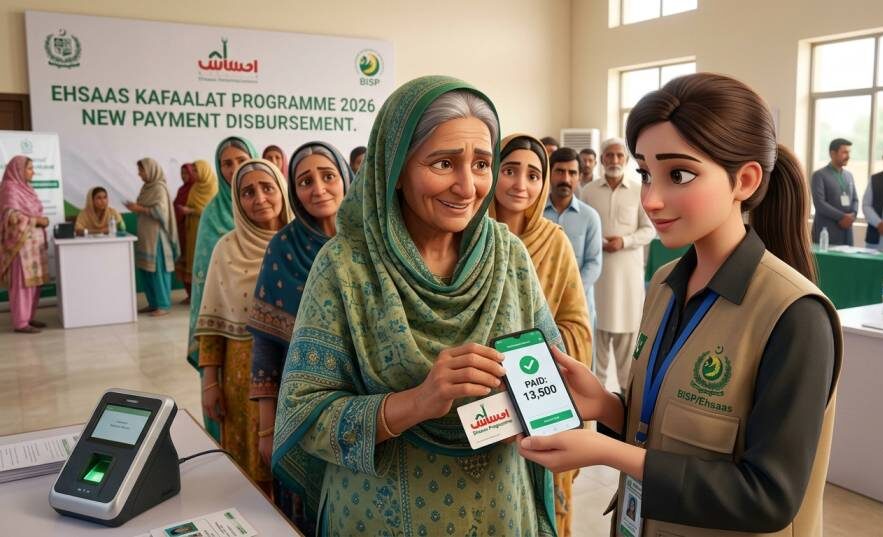
If you have been searching for Ehsaas Programme news lately, you are definitely not alone. Millions of families across Pakistan check their phones every few weeks hoping for a fresh update on payments, registration, or eligibility. With inflation still squeezing household budgets in 2026, the government has rolled out several changes that genuinely matter, from a higher quarterly stipend to new relief packages tied to Ramadan.
This article walks you through everything that has changed this year. We will cover the Ehsaas Programme 2026 payment increase, how the 8171 web portal now works, what the updated eligibility criteria look like, and how to register or fix common problems. Think of this as one stop reading instead of jumping between a dozen confusing websites.
Latest Ehsaas Programme News and Updates for 2026
Let’s start with the headline news, because this is what most people actually want to know first.
Kafaalat Stipend Raised to Rs. 14,500
The biggest piece of Ehsaas Programme news this year is the increase in the quarterly Kafaalat payment. BISP Chairperson Senator Rubina Khalid confirmed that the unconditional cash transfer paid to eligible women under the Benazir Kafaalat component has gone up from Rs. 13,500 to Rs. 14,500 per quarter. The increase took effect with the January 2026 disbursement cycle and was reaffirmed again ahead of Ramadan to help families manage the seasonal rise in food prices.
This change was also reflected in the federal budget. According to figures shared in Pakistan’s IMF staff level report, the BISP budget for the 2025 to 2026 fiscal year was raised by roughly 20 percent to about Rs. 716 billion, one of the largest allocations the programme has ever received. Part of that increase covers the new Kafaalat amount, while the rest goes toward expanding coverage to additional households.
If you are an existing beneficiary, you do not need to do anything special to receive the new amount. It is applied automatically once your account clears verification for the quarter.
PM Ramzan Relief Package Adds Extra Support
Alongside the regular Kafaalat increase, the federal government announced a separate Ramzan Relief Package worth around Rs. 38 billion this year. Under this package, about 2.1 million families who are not already receiving Kafaalat payments were given Rs. 13,000 each as a one time cash grant. On top of that, an additional Rs. 10 billion was set aside to give existing Kafaalat families a small Ramadan top up.
Eligibility for this package is checked by sending your CNIC to the 9999 shortcode, or through the dedicated relief portal. Families already registered with BISP can also confirm their status through the regular 8171 channel, since the two systems are connected.
A More Digital, More Connected System
Beyond the cash figures, the bigger story in Ehsaas Programme news this year is how much the verification process has changed. The 8171 web portal has been updated to show more detail in one place, including your PMT score, payment readiness, and which disbursement point your CNIC is mapped to. BISP has also been shifting away from outdoor payment camps toward retail style collection points such as HBL Konnect outlets and biometric ATMs, which beneficiaries say is faster and less crowded.
There is also a renewed push to keep the National Socio Economic Registry, or NSER, up to date. Officials have repeatedly said that outdated survey data is the single biggest reason deserving families get rejected, so a fresh round of dynamic surveys is being encouraged in tehsil offices nationwide.
Ehsaas Eligibility Criteria: Who Qualifies in 2026
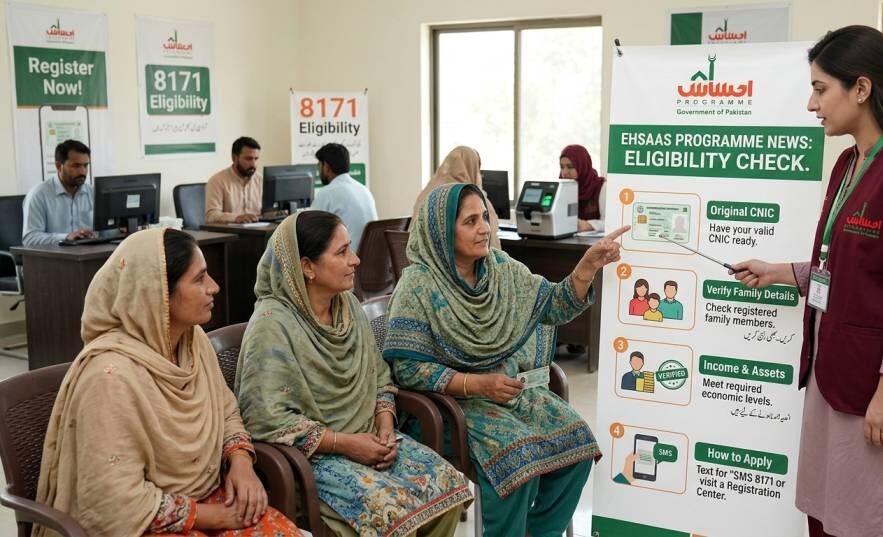
A lot of confusion around Ehsaas Programme news comes down to one simple question: am I actually eligible? Here is how it works in practice.
The PMT Score Decides Everything
Your eligibility is based on a Proxy Means Test, or PMT, score that comes out of the NSER household survey. The score reflects your family’s relative poverty level, and a lower score means a stronger case for support. Most general Kafaalat applicants need a score below the standard cutoff, while households with a verified disabled member are given a slightly relaxed threshold.
This score is not something you can guess or calculate yourself. It is generated when a BISP enumerator visits your home or when you complete the survey at a tehsil office, based on details like household income, assets, number of dependents, and living conditions.
Who Gets Priority
Certain groups are given priority consideration under the current eligibility criteria:
- Women heads of household, since most Kafaalat payments are issued in a woman’s name
- Widows and recently divorced women with no stable income
- Households with a verified disability
- Daily wage earners and low income labourers
- Families with school age children, who may also qualify for the Taleemi Wazaif education stipend on top of the regular payment
If your household income has dropped since your last survey, perhaps due to job loss, illness, or the death of an earning member, you can request a fresh dynamic survey. A lower score from that new assessment can restore or improve your eligibility, but you have to request it. Nothing changes automatically just because your circumstances have changed.
Ehsaas Registration Process: Step by Step
If you are not yet registered, here is the realistic path to follow.
Step 1: Complete the NSER Survey
Registration starts with the NSER survey, not with an SMS or a website. You will need to visit your nearest BISP tehsil office, or wait for a mobile registration van if one is active in your area. Bring your original CNIC, details of household members, and any documents related to income or disability if relevant.
Step 2: Biometric Verification
Once your survey is recorded, you will go through fingerprint based biometric verification to confirm your identity against NADRA records. This step cannot be done online. It has to happen in person, which is one of the most common points of confusion for first time applicants.
Step 3: Check Your Status
After registration, your file moves into the verification pipeline. This is where the 8171 system becomes useful. You can:
- Send your 13 digit CNIC number by SMS to 8171, with no dashes or spaces
- Or visit 8171.bisp.gov.pk, enter your CNIC, complete the captcha, and submit
Either method tells you whether you are eligible, still under verification, or need to take further action.
Step 4: Reapply If You Were Rejected Before
If you applied previously and were marked ineligible, you are not necessarily locked out forever. Many rejections happen because of outdated data rather than genuine ineligibility. Visiting the tehsil office for a re-survey, especially if your financial situation has changed, gives you a real chance at approval in the next cycle.
Ehsaas Payment Update and 8171 Web Portal
This is the part most beneficiaries care about most: how do I actually check and collect my money?
Using the 8171 Web Portal
The 8171 web portal remains the most detailed option. It shows your PMT score, your current Kafaalat payment status, your designated payment point, and any Taleemi Wazaif or Nashonuma stipends linked to your CNIC. Because it pulls data in real time, it is generally more accurate than the SMS reply if the two ever disagree.
Using SMS for Areas With Weak Internet
For beneficiaries in rural areas or those using a basic phone, the SMS method is still the fastest option. Send your CNIC to 8171 and you will get a reply within about a minute confirming your status. No internet connection is required at any stage.
Understanding What the Result Means
Here is a quick reference for the most common status results:
| Status | What It Means | What To Do |
|---|---|---|
| Eligible, Payment Ready | Your Rs. 14,500 installment has been released | Visit your designated payment point with your CNIC |
| Under Verification | Your data is still being processed | Wait 48 to 72 hours and recheck |
| Survey Required | Your NSER data is outdated | Visit your tehsil office to update it |
| Suspended | CNIC expired, biometric mismatch, or inactive data | Fix the specific issue at NADRA or the tehsil office |
| Record Not Found | CNIC entered wrong or not registered | Double check the number, or start NSER registration |
Collecting Your Payment
Once your status shows ready, you can collect your money through a few official channels: BISP payment camps, HBL Konnect outlets, biometric ATMs, or your linked mobile wallet, depending on how your account is set up. You will need your original CNIC and a successful fingerprint scan. If your fingerprint does not register properly, which is common among elderly beneficiaries or those who do manual labour, you can request face verification instead.
Common Issues With Ehsaas Programme News and How to Solve Them
No matter how digital the system gets, a few recurring problems keep showing up. Here is how to handle them.
Ehsaas programme news: Payment Shows Ready But Hasn’t Arrived
This usually comes down to one of three things: a biometric failure at the collection point, a SIM card not registered under your own CNIC, or visiting a bank branch that is not mapped to your account. Confirm your designated disbursement point through the 8171 portal first. If everything checks out and you are still stuck, call the BISP helpline at 0800-26477 with your CNIC ready. They will log a complaint and give you a reference number to follow up with.
Suspended or Blocked Status
A suspended account almost always traces back to an expired CNIC, outdated survey data, or a biometric mismatch. None of these resolve on their own with time. You need to take action: renew your CNIC at NADRA, update your household details at the tehsil office, or request face verification if fingerprints are the problem.
Fake Websites and Scam Numbers
As Ehsaas Programme news has spread, so have copycat websites and unofficial phone numbers pretending to offer registration or faster payments. The only verified channels are the 8171 shortcode and the 8171.bisp.gov.pk portal for BISP and Kafaalat checks, along with official government domains for any special relief packages. No legitimate agent will ever ask you to pay a fee to register, check your status, or receive your payment faster.
Frequently Asked Questions
What is the latest Ehsaas Programme news for 2026? The main update is the increase in the quarterly Kafaalat stipend from Rs. 13,500 to Rs. 14,500, along with a separate Ramzan Relief Package that gave eligible families an additional cash grant during Ramadan 2026.
How do I check my Ehsaas Programme news eligibility? Send your 13 digit CNIC number to 8171 by SMS, or visit 8171.bisp.gov.pk and enter your CNIC after completing the captcha. Both methods will tell you your current status.
What is the current Ehsaas Programme payment amount? As of the 2026 cycle, eligible households receive Rs. 14,500 per quarter under the Benazir Kafaalat component, separate from any additional education or nutrition stipends a family may also qualify for.
Who is eligible under the updated Ehsaas eligibility criteria? Eligibility depends primarily on your household’s PMT score from the NSER survey. Priority is given to women heads of household, widows, people with verified disabilities, and low income daily wage earners.
How do I register for the Ehsaas Programme if I am not enrolled yet? You need to complete the NSER survey at your nearest BISP tehsil office and go through biometric verification. Registration cannot be completed entirely online, since the survey and fingerprint check both require an in person visit.
Why does my status show suspended on the 8171 system? This is usually caused by an expired CNIC, outdated survey data, or a biometric mismatch. Each of these requires a specific fix, either at NADRA or your local BISP tehsil office.
Is the 8171 web portal the same as the Ehsaas Programme website? The 8171 portal is the official verification system used for both BISP and Ehsaas related checks. It is run through the same government database, so checking your CNIC there covers Kafaalat status and several linked stipends.
Can I get help if a payment agent deducts money from my installment? Yes. Report it immediately at your nearest BISP tehsil office. Officials will investigate the complaint, and if it is confirmed, the deducted amount is returned and action is taken against the responsible agent.
Conclusion
Staying on top of Ehsaas Programme news is genuinely one of the easiest ways to protect your household’s access to support. The 2026 updates, from the Rs. 14,500 Kafaalat increase to the expanded Ramzan Relief Package, show that the government is still actively adjusting this system to match rising living costs. The tools to check your status, the 8171 SMS service and the official web portal, are free, fast, and available to absolutely everyone with a basic mobile phone.
The most important habit you can build is checking before you act, whether that means confirming your payment status before a collection trip or verifying your eligibility before assuming you have been left out. Keep your CNIC and survey data current, rely only on official channels, and visit your tehsil office directly whenever something does not resolve itself digitally.
Disclaimer: This article is published for informational purposes only. We are not affiliated with any government department. For official information, please visit the relevant government portals.